A long read · 01 — 10
Security & Data Ownership.
Most security pages start with a list of encryption standards. We start with the architecture, because architecture is what makes the standards meaningful. Your business data does not live on our servers. It lives on the appliance in your office. That is the entire foundation of how Dino AI Hub is built, and it is the reason we can make claims on this page that no SaaS vendor in your category can match.
This page is the operationally honest version of those claims. It names every seam. It tells you exactly what we see, exactly what we cannot see, and exactly what happens when something goes wrong. If anything here is unclear or you want a deeper technical answer, the conversation is always open.
01
Where your data actually lives
Your customer list. Your job history. Your call recordings. Your quotes, invoices, payments, P&L. Your service technicians' notes. Your equipment records. Every photo from every job. Every text message exchanged with a customer.
All of it sits in a database on the appliance in your office. Encrypted on the disk. Backed up to whatever destinations you choose. Reachable only by the people you authorize, over connections you control.
It is not replicated to a Dino AI Hub server. It is not synced to an “anonymized analytics” pipeline. It is not warehoused in a customer-data lake we operate. There is no copy of your business anywhere outside your premises and the backups you decide to keep.
This is not a policy choice. It is how the product is built. Removing this guarantee would require rewriting the product.
02
Third parties, named and limited
No software exists entirely on its own. Phones connect to a phone network. Cards process through a card network. Some integrations are valuable enough to be worth depending on. The honest version is to name every third party that touches anything related to your business, exactly what passes through them, and what does not.
Twilio
Twilio carries the telephony — incoming and outgoing calls, SMS to your customers. Voice and message transit through Twilio in real time. Twilio is configured for the minimum retention their service permits, and call recordings are pulled to your appliance and stored there. The voice receptionist itself runs locally on your hub; Twilio is the phone line, not the brain.
Stripe
Stripe processes card payments. When a customer pays an invoice or a tech runs a card at the kitchen table, the transaction goes through Stripe the same way it would for any business. Stripe sees card numbers and transaction amounts; that is the nature of card processing. Stripe does not see your CRM, your quotes, your call recordings, or anything else.
Bright Data
Bright Data is the only integration named here that is a one-way street, and the direction is inward. We pull lead enrichment and prospecting data from them into your hub. No information about your business or your customers ever flows back to Bright Data.
Cloud LLMs
Cloud LLMs — with your explicit consent, and only when needed. By default, every AI conversation in the system runs on the local models inside your appliance. There is one exception: when call volume gets high enough that the local hardware reaches its concurrency ceiling, the system can offload overflow conversations to a cloud language model. This only happens if your business has explicitly agreed to it during onboarding. If you do not agree, the system never routes a single conversation to a cloud LLM — overflow falls back to voicemail or to a human, never to a third-party model. If you do agree, only the conversations that exceed your local capacity get routed, and you can revoke the consent at any time, after which the system stops using cloud LLMs immediately.
That is the complete list. There is no fifth vendor we forgot to mention, no analytics provider quietly receiving customer events, no advertising pixel embedded somewhere. If a future integration is added — for an accounting platform, a calendar service, anything — it gets named here on the same day it goes live.
03
What we cannot be compelled to hand over
Subpoenas, legal holds, government data requests, civil discovery, and warrants only reach what a company actually possesses. We do not possess your customer list, your call recordings, your financials, or anything else from your operation. We cannot produce what we do not have.
A SaaS vendor sitting on your data has no choice but to comply when a court orders them to. We are not in that position.
If anyone — an opposing party in a lawsuit, an agency, a competitor pretending to be one — wants access to your business data, they have to come to you, not to us. You are the only party with the keys.
This is the single sharpest distinction between Dino AI Hub and any cloud-hosted competitor, and it is structural. We could not give them your data if we wanted to.
04
How the device is hardened
The appliance ships sealed. That word is doing real work.
Disk encryption at rest
Full-disk encryption is enabled before the appliance leaves us. The database itself is encrypted on top of that. Even with physical access to the hardware, the data on the drive cannot be read without the key.
Encrypted in motion
Every connection between your appliance and the surfaces that use it — BOS in the office, Field on technician phones, Portal for your customers — runs over an encrypted tunnel. Outside parties cannot intercept the traffic between a tech in a basement and the hub in your office.
Locked-down operating system
Browser downloads are disabled on the appliance. No additional software gets installed on it. No one in your office uses it as a general-purpose computer. The fewer doors there are, the fewer can be opened by someone you did not authorize. This is the difference between a server running one application and a desktop running fifty.
No physical seal-breaking required from you
Updates, fixes, and new features arrive over the encrypted tunnel from us. There is no scenario in which you should be opening the box, plugging in unknown drives, or installing software on it. If anyone tells you to, the request is not legitimate.
05
Your backups, your keys, your locations
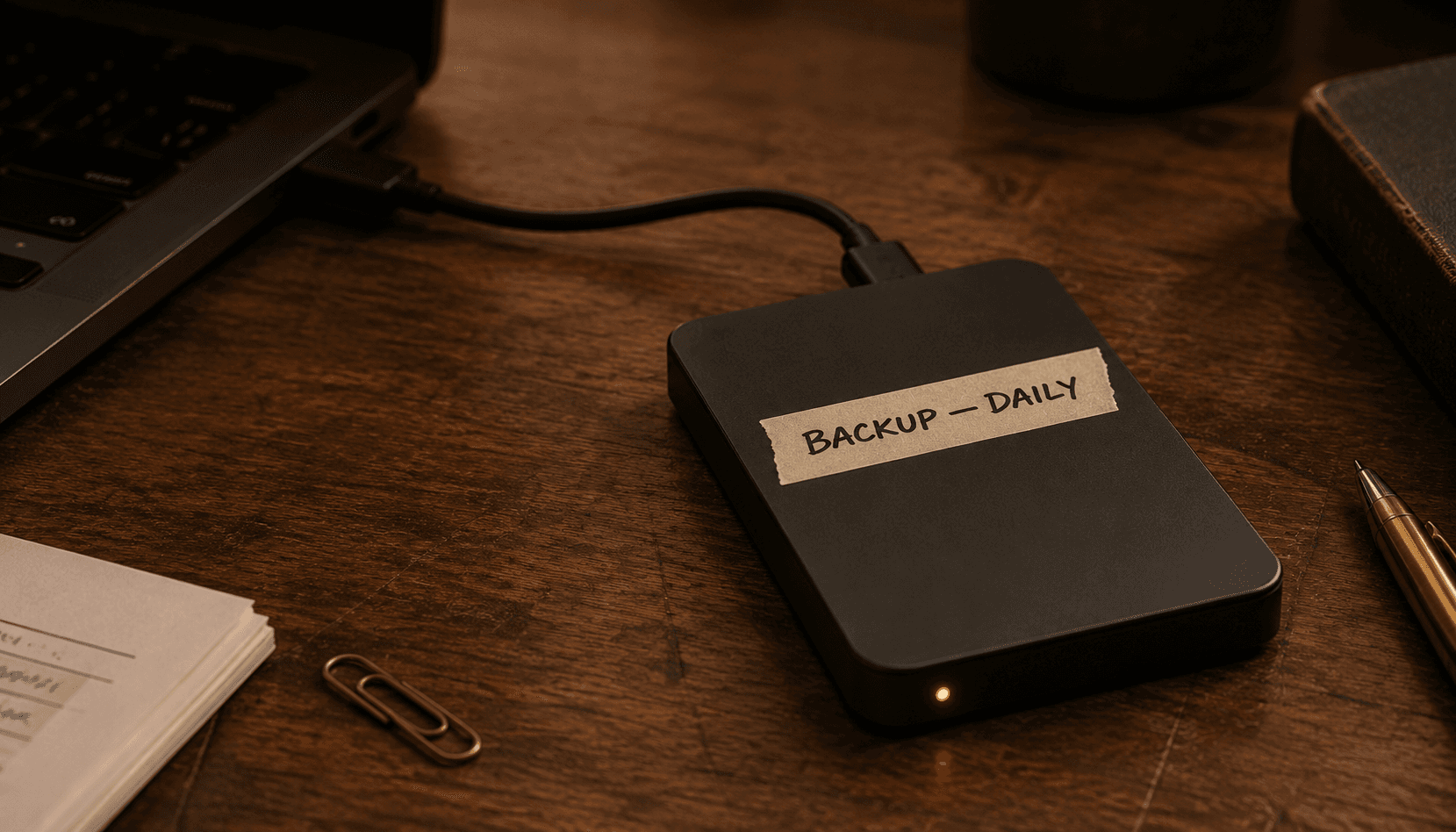
Backups are not optional. We recommend two layers — a daily and a monthly — and the choice of destination is yours.
A second drive in your office. A NAS in the closet. An encrypted off-site service of your choosing. All of the above. The keys are yours. The destinations are yours. We are not in the loop.
This matters specifically because backups are the most common place data ownership quietly leaks. Many SaaS products will happily back you up — to their cloud, with their keys, on their schedule. The “backup” becomes another copy they hold. Yours never works that way.
06
Support and remote access — the honest section
This is the seam most likely to undermine claims elsewhere on a security page. If support staff can reach into a customer's system whenever they want, much of the rest of the page is theater. Here is exactly how it works.
When you need help, we connect through the encrypted tunnel that already runs between your appliance and us. There are two access modes:
SSH access for technical debugging
A command-line connection into the appliance, used when something needs to be inspected or fixed at a system level. Requires your explicit consent per session — meaning every time we connect, you approve that specific session. The connection is not standing open. It is opened on your authorization, used for that work, and closed.
Screen-share for collaborative troubleshooting
When the issue is best diagnosed by walking through the interface together, we screen-share with you watching. Same per-session consent model.
Auditable from your side
Every access event — when, by whom, what type — is logged on the appliance itself, in a record you can read at any time. You can audit our access whenever you want. The audit log lives on your hardware; we cannot edit it from our side.
That is the entire mechanism. No silent VPN tunnel that stays open. No “support staff with persistent credentials.” No automated processes reaching in without your knowledge.
07
What we see centrally
We do see four things, and only four things, from the appliance in your office.
Hardware health
Disk usage, temperature trends, memory pressure, drive SMART data — the operational signals that tell us if your hardware is about to fail. When we see warning signs, you hear from us before you see a failure.
Crash reports
When the software encounters an error, a structured crash report is sent — what crashed, what version, what platform. It contains no customer data, no business records, no recordings. It tells us a process failed; it does not tell us what the process was doing for which customer.
Version numbers
Which release of the software your appliance is currently running. So we know who to push the next update to.
License validation pings
A heartbeat that confirms your license is active. Yes, no, and that is the entire payload.
That is the complete list. Nothing else is transmitted from your appliance to us, by design.
08
When you stop being a customer
Whether you sell the business, switch back to SaaS, or simply walk away, your data stays with you because it was always with you. There is no migration to perform out of our cloud, because there is no copy of your data in our cloud. Whatever was on the appliance in your office on day one is still on the appliance in your office on the day you stop.
If you want a clean export — every table in standard formats, openable in any spreadsheet program or importable into any other system — the appliance can produce a full CSV or JSON export at any time. Customers. Properties. Jobs. Quotes. Invoices. Payments. History. Everything in your database, in formats nobody has to reverse-engineer.
The product is built so leaving is straightforward. That is a deliberate architectural choice and a deliberate brand promise. Lock-in is a SaaS-business strategy. We have no business need to lock anyone in, and so we do not.
09
What we structurally cannot do
It is worth ending with the contrasts, because they are sharper than they sound.
We cannot sell your customer data,
because we do not have it.
We cannot be hacked into your customers' records on our side,
because they are not on our side.
We cannot be acquired by a larger company that quietly monetizes your data,
because we have no data to monetize.
We cannot change a privacy policy that suddenly opens your business records to “improving our AI models”,
because your business records are not within reach of any model we could improve.
We cannot have a rogue employee exfiltrate your customer list,
because our employees have no access to your customer list.
We cannot hand over your data in response to a subpoena,
because we cannot hand over what we do not have.
Each of these is a real failure mode that has happened to real businesses on real SaaS products in the last several years. None of them is possible here, by construction.
10
A note on certifications
The standard security certifications — SOC 2, ISO 27001, HIPAA attestations, and the like — exist primarily to give buyers confidence that a SaaS vendor's cloud infrastructure is secure. They certify the practices a vendor follows when they hold your data.
Dino AI Hub is built so that we do not hold your data, which means most of what those certifications certify does not apply. The strongest possible assurance is the architecture: there is no cloud database to audit, no employee access to your records to control, no third-party SaaS vendor in our supply chain holding your business. The structure is the security.
If your industry requires a specific compliance posture — a regulated practice, a government contract, an insurance carrier that demands certain controls — we will discuss it directly with you. For most home-services businesses, the architecture answers the question more completely than any certificate could.
Ready to talk through any of this in detail.
Some buyers want a deep technical conversation before committing. We welcome it.